


It was 11 years ago that Elizabeth Berry and her husband, Fred, moved from Berkeley, California, to northern New Mexico. Fred had found an old ranch just north of Abiquiu. Along the route of the old Conestoga trail between Santa Fe and Green Rivers, it is reachable now only by a 17-mile dirt road and is surrounded by protected land. Of course, one of the first improvements to the farm was a garden. It shortly astounded them both with its beauty and productivity. Soon came an association with Mark Miller and his now-famous Coyote Cafe. For him Berry planted an acre of specialty crops, such as arugula, baby corn and squash blossoms. Thus began her transformation from gardener to market farmer.
Berry now has five acres near a highway where she produces gourmet vegetables for 25 top chefs in New Mexico. They vie for her vegetables because they are beautiful and because she always has some new and interesting variety. And if the chefs want to choose the varieties, so much the better. One mentioned that he couldn't find an eggplant as good as one he had in Italy. Berry searched for it, and soon he was the primary customer of her 'Alfredo' eggplant. Almost from the beginning she has organized large, chefs-only tastings of tomatoes (60 kinds), squash (35 kinds) and other vegetables to further educate the palates of her sophisticated clients.
Bean Beginnings
About the same time she started the market garden, Berry heard about the Seed Savers Exchange and admired the group's devotion to preserving endangered heirloom and open-pollinated vegetable varieties. So she volunteered to grow samples of anything they wanted. One of the bean samples was, in Berry's words, "a mess"; that is, it contained a mishmash of different varieties. She returned a small sample to Seed Savers and kept the bulk of the crop. After a few years of trying to market these beans and others she had started to grow,she decided that chefs-only tastings might be the answer for dried beans, too.
The first bean tasting was in 1989. Berry cooked 23 varieties of dried beans and served them plain, with no seasonings and without even salt. Her rules were simple: Chefs wanting to participate had to commit to buying a commercial quantity of at least one bean for their restaurant the following year. They also had to produce one recipe featuring that bean. It worked. Berry collected orders and recipes, and the chefs were happy to have an unusual or unique bean to offer in their restaurants.
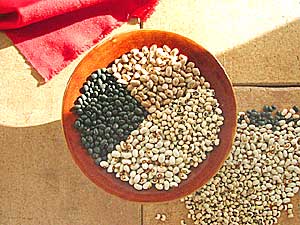
Most important, an heirloom was freed from the collections of specialists and grown in commercial quantity. "People talk at length about saving heirloom beans," says Berry. "But what good is it to have only collections of heirloom beans? It's better to reintroduce them to the world, and the best way to do that is through creative chefs." Hence the idea of reintroducing beans became Berry's mission. One summer she grew 65 varieties of beans, most of them from the Seed Savers Exchange, for chefs-only taste testings. The beans we feature here are the cream of the crop from the six tastings she's held to date.
Elizabeth's Flavorful Beans
These beans have more going for them than just good looks or antiquity, though both add to their charm. They are all among the top varieties in one of Berry's annual tastings for chefs. The varieties vary widely in flavor, texture anappearance. Some retain colors, patterns and shape after cooking, but others don't. Some beans absorb and complement flavors from accompanying spices, meats and vegetables; others have assertive flavors of their own. Textures range from silky smooth to firm.
In the garden, the main difference between varieties is height of the plants, ranging from one foot to 15 feet high. They are grouped below into the low (bush and half-climbers) and tall (runners or climbers that require support).
Most beans here are varieties of the common bean (Phaseolus vulgaris). A few are runner beans (P. coccineus). Both species originated in tropical America. The runner bean is perennial in its native climate, but in North America it's usually treated as an annual. All are open-pollinated, so in every case you can save a few seeds to plant next year and be assured to harvest the same variety again.
Bush Beans, One to Three Feet High
Esther's Swedish. (90 days) A smaller-than-usual Swedish brown baking bean that holds its texture and shape. Fred Berry got it from a friend in Montana, whose family passed it down for generations. Tan-brown with a tiny, white eye.
Flavor: light
Texture: tender
Flageolet. (100 days) Favored by the French and Italians both as a shell bean and as the dried bean in classic cassoulets. Bakes well, or for use in soups. Excellent with meats. Pale green to white.
Flavor: delicate
Texture: creamy
Flor deMayo. (100 days) A small and beautiful bean from Guadalajara via a man who worked for Elizabeth Berry. Its color varies from lilac to purplish to tan-blue.
Flavor: mildly sweet and smoky
Texture: slightly firm
Jacob's Cattle. (100 days) Also called Trout or Dalmatian bean, this famous heirloom from Germany is a distinctive maroon with white markings. Cooked, it absorbs other flavors while remaining intact.
Flavor: sweet
Texture: firm
Textu New Mexico Black Appaloosa. (100 days) Native to Mexico and the Southwest, this bean is speckled black and white. Cooks quickly and is used like a pinto bean. Also available in red form.
Flavor: mild
Texture: smooth and creamy
Painted Pony. (100 days) This small bean has particularly distinctive markings. Colors are brown over white, but always with a white eye shadowed in black. After cooking, the pattern remains distinct.
Flavor: delicate
Texture: creamy
Raquel. (100 days) Berry has traced the roots of this rare heirloom bean to Chihuahua, Mexico. The color is yellow-ochre on white.
Flavor: nutty
Texture: meaty
Vermont Appaloosa. (100 days) This bean is half cream colored and half maroon with cream markings. The boundary between the two halves has a distinctive, ragged edge.
Flavor: woodsy
Texture: smooth
White Aztec. (100 days) Berry's number-one best-seller, this runner bean stays under three feet and doesn't require staking. The pure white beans are very large and round. They have been cultivated in the southwestern U.S. for hundreds of years.
Flavor: full-bodied and nutty
Texture: smooth and starchy, potato-like
Pole or Runner Beans,Three to Six (or more) Feet High
Borlotti. (105 days) A classic Italian pole bean, this medium to large bean is tan splashed with red-black or magenta streaks.
Flavor: nutty
Texture: firm
Black Runner. (105 days) A beautiful variant of the Scarlet Runner bean. A flavorful snap bean when very young, it goes on to produce long pods full of deep black beans.
Flavor: sweet and rich
Texture: somewhat firm
Giant Pinto. (105 days) This buff bean w Cooked, the flavor is very much like that of ordinary pinto beans. Unlike most beans, it retains its distinctive markings after cooking.
Flavor: rich
Texture: smooth
Madeira. (100 days) Brought to the U.S. by emigrants from Portugal and Italy. A large cranberry bean with distinctive light tan skin mottled with red-maroon. Three to four feet high.
Flavor: nutty
Texture: firm
Mauve Runner. (105 days) A color variant of Scarlet Runner, this bean is lavender with deep purple to black flecks. Young purplish pods can be eaten as green beans.
Flavor: potato-like
Texture: smooth and starchy
Scarlet Runner. (105 days). Named for its red flower, this bean has long been popular in Europe. It produces well under slightly cool conditions. Reaching 10 to 12 feet, it requires a substantial trellis. Immature pods are edible. The large bean is purple mottled with black.
Flavor: potato-like
Texture: smooth and starchy
YingYang. (100 days) This is a rare heirloom variety that Berry maintains in three separate color forms. (They require different cooking periods.) Half the bean is white and half is either red, yellow or black. A curved boundary divides the two colors, and there is a single dot of color in the white half.
Flavor: rich
Texture: smooth
How to Grow Beans
Wait to plant until soil is thoroughly warm, usually a week or so after the average date of last frost for your area. In the South, that means early April; in the North, early June.
Sow seeds about one inch deep and four to six inches apart. Plant smaller seeds 1/2 inch deep and four inches apart. Sow six seeds of pole beans around each pole, then thin to three plants. If your soil tends to crust, cover seedbed with a light mulch.
It's best if soil is kept moist one to two inches below the surface. This is especially important just before and after germination, and later when seeds are developing inside pods.
The Mexican bean beetle is the most troublesome bean pest in the East. These are copper-colored beetles with 16 black spots. They chew and consume soft tissue of leaves until only lacelike veins remain. The pedio wasp (Pediobius foveolatus) is a commercially available parasite of bean beetles. Spined soldier bug (Podisus maculiventris) is a helpful predator.
Harvest and Shelling
Most of Berry's favorite beans can be harvested and used in three distinct ways. Pick them young for green beans. In fact, several of the winners from her dry-bean tastings are traditional snap-bean varieties. Or pick them after the beans inside have swelled to full size but are still soft and a little green: These are shell beans. Cook them immediately while the beans are tender and fresh. And of course, the traditional way is to allow beans to dry on the plant. Dry beans are ready to harvest once the pods are brittle and stiff.
Berry harvests and cleans dry beans by hand. The dry pods are picked just before they begin to split open. The pods are put on a tarp and beaten with a stick. Then everything on the tarp is transferred to washtubs or trash cans. The largest chaff is removed by hand as the work proceeds. On a windy day, the beans are poured from one bucket to another. The heavier beans separate easily from most of the chaff. Finally, the beans are poured onto a wide tabletop covered with burlap or another coarse fabric. Damaged and off-type beans are removed by hand. As the beans are dragged across the fabric, dust and dirt fall through the weave, leaving the beans shining and clean.
Storing Beans
Dried beans keep for years in an airtight container, but it's ideal to cook them within a year of their harvest. Be sure that they are really dry before putting them away. One test is to put a sample in a closed glass container: You'll see moisture condense inside within a day if the beans are not dry. In arid climates like New Mexico's, Berry recommends storing beans in paper bags or some other container that can breathe, in a cool, dark place. Also take precautions against weevils. Their eggs can hatch inside sealed containers. If weevils were a problem in your garden, expect them on your beans. Freezing will kill larvae and eggs, so putting dried beans in the freezer for a time is a simple control.
Michael MacCaskey is the former editorial director at National Gardening.
Photography by Sabin Gratz/National Gardening Association
 Victory Seed Company has all the seeds you want for your best garden in 2024.
For 25 years, the family-owned Victory Seed Company has provided the highest quality vegetable, herb and flower seeds to families across the country. We are passionate about providing you the best seeds available that give excellent germination, robust plants, and the harvest you want. With a catalog of over a thousand varieties, we have everything, and our prices are the kinds that we'd want to pay. We have hundreds of yesterday's heirloom vegetables, as well as today's award winning hybrid selections. Get to know us by visiting our website and browsing through our online vegetable seed catalog.
