

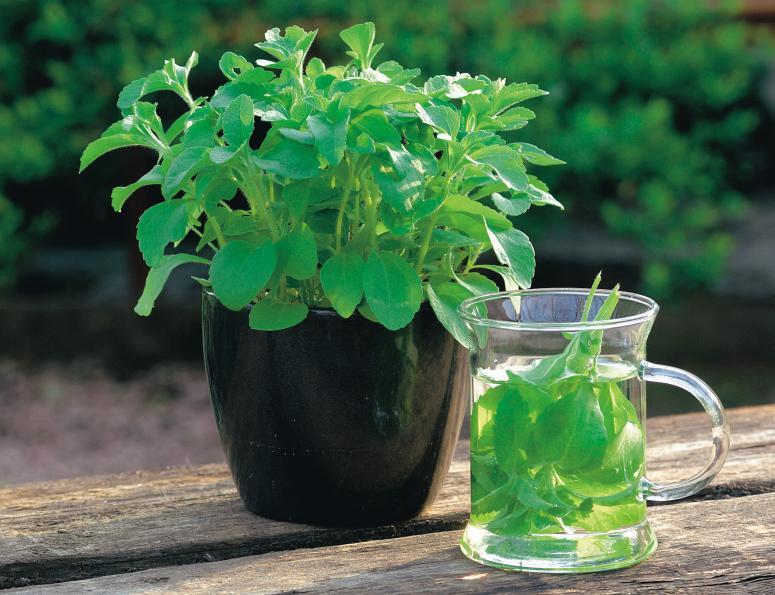
Herbs are clever plants. Just in case their good looks aren't enough to pique our interest, they offer something extra, such as unique flavorings or scents. One herb, Stevia rebaudiana, goes a step further by appealing to our sweeter side. This plant packs so much sweetness into its leaves that they can be used in place of sugar, and plant extracts are commonly used as sweeteners in Japan, China, and South American countries. One dried leaf, ground, is 10 to 15 times sweeter than an equal amount of sugar, and powdered extracts made from the leaves are up to 300 times as sweet - without the calories.
The U.S. Food and Drug Administration banned the sale of stevia products in 1991, but three years later approved their sale as "dietary supplements." In FDA jargon, dietary supplements can carry claims of providing health benefits, but they cannot be marketed as conventional foods or food additives. Thus, stevia cannot be sold for use as a tabletop sweetener, which is considered a conventional food, or as a sweetener in teas or other products. Nonetheless, people can buy stevia powder and use it in place of sugar at home.
The substances responsible for the plant's sweetness are chemicals called glycosides, primarily one dubbed stevioside, which are concentrated in the leaves. These and other related chemicals are at their peak just before flowering, which is triggered by the shorter days of late summer and early fall.
Growing Stevia
In the wild, the plant grows in infertile, moist, sandy soil near streams and marshes. It reaches a height of about 2 feet (up to 3 feet in cultivation), with many branches and attractive, slightly serrated, opposite leaves. The pretty flowers are tiny and white with a pale purple throat, but they must be pinched off or they will steal sweetness from the leaves.
Stevia likes heat and can be grown as a perennial in frost-free areas. Elsewhere, the best approach is to treat it as an annual herb such as basil. For best results, plant stevia in the garden for the summer, harvest the fresh leaves before flowering, and dry them for later use.
Transplants can be ordered from a mail-order nursery in the spring and planted in the ground when the soil temperature reaches about 65°F. A sandy loam with a slightly acid to neutral pH and good drainage is important. If your soil is heavy clay or otherwise slow-draining, plant in a raised bed or container filled with lightweight soil mix. (Because the stems tend to be brittle, group plants close together so they can help each other withstand winds and rain.)Stevia has a temperamental nature that is often reflected in slow growth when the plants are first set out. After the first month, they pick up speed. They're not picky about fertilizer; any general liquid fertilizer, such as a 20-20-20, applied once a month during the summer will do. Pruning and pinching encourage bushy plants. Always pinch off flowers in order to produce the sweetest leaves.
When fall arrives, it's time to harvest the leaves. Pull up the plants in the early morning and remove the leaves, then dry them in the sun for about 24 hours. When crispy dry, the leaves can be stored in a plastic bag or airtight jar. They can be ground easily in a mortar and pestle or in an electric spice or coffee grinder.
One way to extend the harvest of sweet leaves is to overwinter garden plants indoors, or order stevia plants in the fall and grow them inside until spring. Pot them in a lightweight soil mix and keep them in a 70°F room.
If you like to experiment, you can make your own cuttings from outdoor plants during the summer. Three-inch tip cuttings dipped in rooting hormone will root in sand if misted frequently. Stevia cuttings can also be rooted in water. Grow lights are essential to keeping stevia plants happy indoors. Even under ideal conditions, it's not uncommon for plants to die suddenly or to lose leaves and appear dead, but as long as the roots are alive, they may regrow.
Cooking with Stevia
One fresh stevia leaf is enough to sweeten a cup of tea or coffee or a glass of lemonade. Or add the leaves to baked beans, barbecue sauce, salad dressings, soups, and stews.
Unlike some other sugar substitutes, stevia is stable when heated, so the powder can be used in baking. However, this requires a willingness to experiment. Much less stevia powder is needed for the same level of sweetness provided by sugar, but sugar also adds volume, so liquid and dry ingredients will need to be adjusted. Estimates vary widely because of natural variation in the plant, but figure that between 1 teaspoon and 1 tablespoon of dried, ground stevia leaves equals about 1 cup of sugar.
A Sweetener and More
The Japanese have been using stevia to sweeten products since the 1970s, and plant extracts are now found in candy, ice cream, pickles, soft drinks, teas, and other foods. The herb also had great potential for use in this country a decade ago. Major food companies such as Thomas J. Lipton and Celestial Seasonings were developing products containing stevia. Those efforts screeched to a halt when the FDA temporarily banned the importation of stevia products in 1991.
Stevia is also purported to do more than sweeten foods. It's touted as helping to fight tooth decay and gum disease by inhibiting bacterial growth. It has been investigated as a blood sugar regulator for people with diabetes and hypoglycemia. Because stevia contains virtually no calories, it could have potential for use in weight-loss diets. However, none of these uses has been approved in the U.S., and controversy surrounds them as well as stevia's potential role as a sugar substitute.
More About Stevia
If you're interested in learning more about stevia and how to cook with it, check the following books and Web sites. Stevia is available in granular, powder, and liquid extract forms at health food stores.
Stevia: Naturally Sweet Recipes for Desserts, Drinks, and More by Rita Depuydt (Book Pub Co., 2002; $14.95). A book of recipes.
The Body Ecology Diet by Donna Gates and Linda Schatz (B.E.D. Publications, 2002; $24.95). A book of recipes.
Stevia: Nature's Sweetener by Rita Elkins (Woodland Publishing, 1997; $3.95). A book of recipes.
Stevia Rebaudiana: Nature's Sweet Secret by David Richard (Vital Health Publishing, 1999; $5.95). This book covers the history, botany, and safety concerns and offers recipes as well.
The Stevia Story: A Tale of Incredible Sweetness and Intrigue by Linda Bonvie, Bill Bonvie, and Donna Gates (B.E.D. Publications, 1996; $6.95). This is a well-researched history of stevia's uses and the controversies surrounding them. Also included are cultivation tips.
Stevia Sweet Recipes by Jeffrey Goettemoeller (Vital Health Publishing, 1999; $12.95). A book of recipes.
For good Web sites, try the following:The Raintree Group, Inc.
 Victory Seed Company has all the seeds you want for your best garden in 2024.
For 25 years, the family-owned Victory Seed Company has provided the highest quality vegetable, herb and flower seeds to families across the country. We are passionate about providing you the best seeds available that give excellent germination, robust plants, and the harvest you want. With a catalog of over a thousand varieties, we have everything, and our prices are the kinds that we'd want to pay. We have hundreds of yesterday's heirloom vegetables, as well as today's award winning hybrid selections. Get to know us by visiting our website and browsing through our online vegetable seed catalog.
